
How to Avoid Regret: Why You're Not Living as Your True Self
Jul 17, 2026How to Avoid Regret: Why You're Not Living as Your True Self
Most people will tell you their biggest fear is failure. But if you actually watch how people live — the choices they avoid, the conversations they dodge, the distractions they reach for — you'll notice something different. What people are truly running from isn't failure. It's regret.
We hear it in every leadership talk and self-help post: "Your biggest pain in life will be regret." Yet almost nobody sits with that idea long enough to understand it. Instead, we do everything in our power to avoid getting close to it.
The Distraction Trap
There's an old philosophical idea — some trace it to the Middle Ages — that all of man's problems begin when he can't sit alone in a room for thirty minutes without distraction. In the modern world, that idea has taken on a much sharper edge. Distraction is no longer occasional; it's constant. Our phones are built for it. Our schedules are built for it. Even our ambition can become a form of it.
Most people assume they reach for their phone, or fill their calendar, or chase "one more task" for entertainment or productivity. But underneath that behavior is something else: discomfort. Sitting with your own thoughts and emotions — especially the ones tied to fear about the future or guilt and shame about the past — is uncomfortable. So we distract instead.
This is especially true for high performers. Distraction, for them, doesn't look like laziness — it looks like hyper-focus on work. Staying busy and productive becomes the socially acceptable way to avoid the internal conversation that actually needs to happen. In the short term, this works. It even looks admirable. But over time, it piles up — and it's often the very thing that leads to regret down the road.
Self: The Concept Nobody Actually Defines
To understand regret, you have to understand what regret is actually measuring you against — your self.
Most people equate "self" with personality. We describe ourselves as introverted or extroverted, adventurous or cautious, and treat that as the full picture of who we are. But personality is only a surface layer. At a deeper level, none of us fully know who we are at our core — whether you frame that core as your soul, in the religious sense, or as your deepest values and the way you naturally show up in the world.
Self is also shaped by culture — your ethnicity, your religion, the region you were born into. Combine personality and culture, and you get a powerful, often invisible blueprint for how you're "supposed" to behave. You start chasing a version of success or freedom that was defined for you before you ever had the chance to define it yourself — the corporate ladder, the American Dream, "five years and I'll be free."
Here's the catch: when people actually try to define what that freedom looks like — tangibly, specifically — they usually can't. It's a vague cluster of ideas, not a real vision. And if you never define it, you can spend years chasing something you never actually wanted, and land, right on schedule, in regret.
Where Your Idea of "Self" Actually Comes From
Here's the deeper root of the problem: your personality and cultural identity weren't created by you. They were handed to you — through the interpretation of your parents, teachers, peers, and anyone else who had credibility in your life. You've been looking in a mirror since childhood, both literally and socially, slowly assembling a picture of "who you are" based on what other people reflected back at you.
That's not inherently bad. There are real, good things within your personality, your culture, and your upbringing. The problem isn't that these influences exist — it's that most people never separate what was given to them from what is actually theirs.
At the deepest level, self is less a fixed identity and more an ongoing experience. Even from early childhood, some philosophers and psychologists describe humans as having a kind of "oceanic consciousness" — a felt sense of being part of something larger, before culture and language step in and start drawing hard lines around who you are and aren't. Nearly every religious tradition, at its core, points to some version of this same idea: unity, interconnection, one underlying energy or force.
Two forces are constantly at work in shaping you: the drive for authenticity — the pull back toward that deeper, integrated self — and the drive for attachment — the very human need to belong, to be understood in relation to other people. You can't even describe yourself without referencing others: I am a parent. I am a business owner. I am a son. This is precisely why culture and religion have such a powerful grip on identity — we are, at our core, a social species.
The Two Things You Need to Avoid Regret
If regret comes from living out of sync with your true self, avoiding it requires two things.
1. Understand your ideal self — through your own experience, not other people's interpretation.
This isn't about landing on the right words or borrowing someone else's definition of who you should be. Words like "soul" or "values" are just fingers pointing at the moon — not the moon itself. The real work is going back through your own life experiences — the painful ones included — and asking what they actually taught you, rather than accepting what others told you they should mean.
This is uncomfortable, because our minds naturally shield us from painful memories. It's far easier to remember the good and let the bad stay buried. But real growth requires looking directly at the moments you regret and asking: what did I actually learn from this?
2. Define your future self — and let your past inform it, not define it.
There's a simple but powerful concept in psychology: everyone has a current self and an ideal self. The gap between the two is what creates either growth or stagnation, depending on which direction you're moving. If you don't consciously define what your ideal self looks like, your mind will default to fear — fear about the future, fear of loss, fear of not doing enough or doing too much. Most of those fears, notably, are cultural ideas in disguise.
When you do the work — processing your past honestly, without living in guilt or shame, and pointing yourself toward a clearly imagined future self — you start to move with direction instead of anxiety. And when you're moving toward who you actually want to become, even imperfectly, you suffer less. When you're moving away from it, regret and internal misalignment start to build.
The Trifecta
Put simply, avoiding regret comes down to three steps:
- Separate who you are from the personality, culture, and religious models you inherited. Not to reject them — but to consciously choose what's actually yours.
- Look honestly at your past experiences — the good and the uncomfortable — and extract what they taught you, rather than only what others told you they meant.
- Define your ideal future self, even if only the next step toward it, and let that vision — not fear — guide your direction.
None of this is easy. It's simple in concept, but genuinely difficult in practice, especially because growth often puts you at odds with the people and environments that are used to the old version of you.
The Real Question
Ultimately, avoiding regret isn't about achieving more or optimizing your schedule to avoid mistakes. It's about alignment — closing the gap between who you are at your core and how you're actually living, day to day.
So ask yourself honestly: when you picture yourself five years from now, can you actually see it? Or are you simply assuming you'll be the same person, doing the same things, for the same reasons? If you've been on any kind of real growth path, the answer should surprise you.
What was your biggest insight from this? Has your experience with regret looked similar — or different?
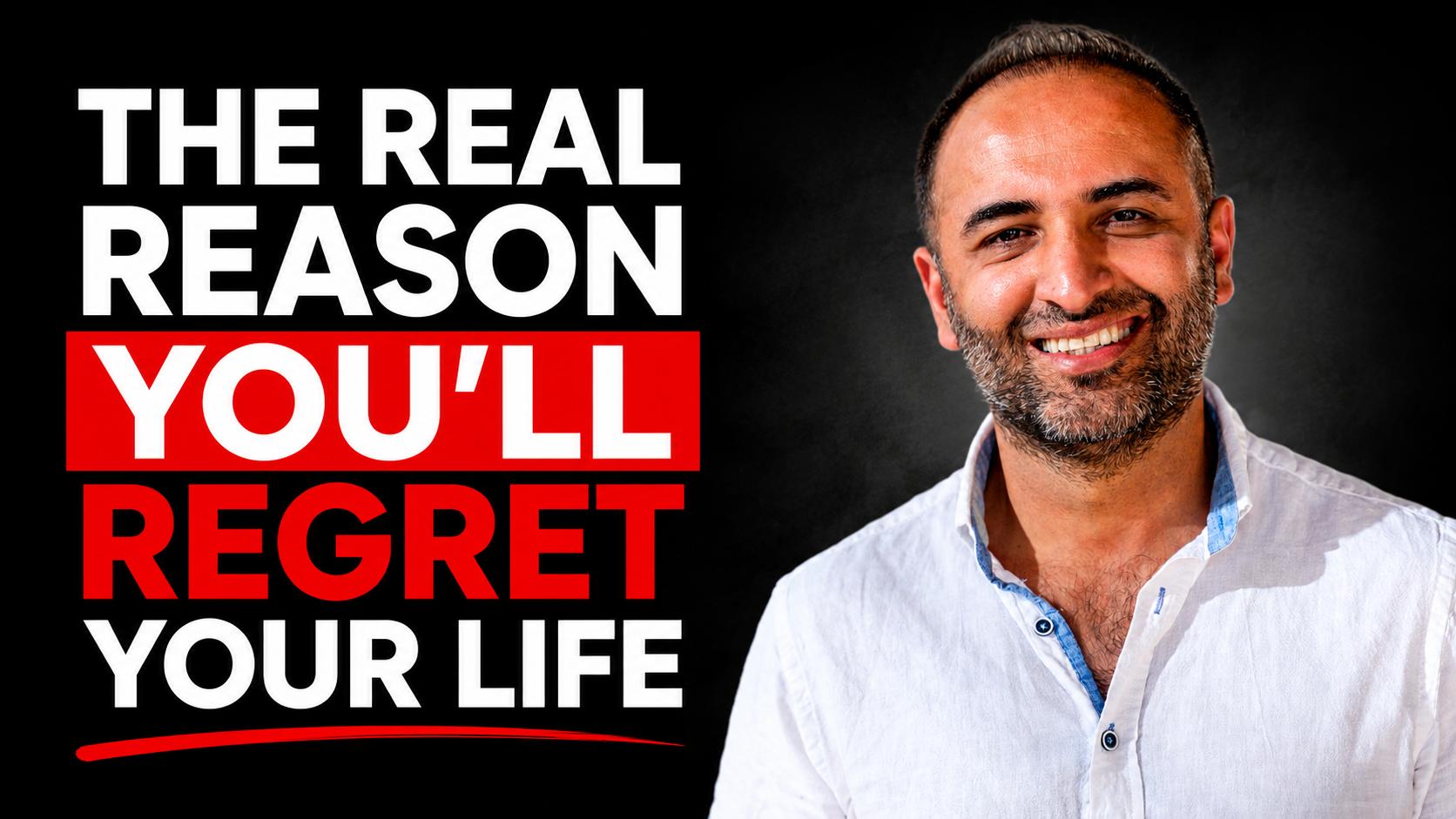 TRANSCRIPT
Faisal Ensaun: Hello, amazing leaders. I want to jump in and talk about avoiding regret. Faisal Ensaun: I love this topic for a couple of reasons. One, that most people… you hear all kinds of posts and speakers talking about this, that your biggest pain will be regret, but if you actually watch people in their day-to-day life, they will do everything in their power to avoid any discussion that gets them close to regret. Faisal Ensaun: close to understanding what they will regret more accurately. And usually, regret happens when you're living out of sync with what truly matters to you in your core, or in your soul. Faisal Ensaun: So, here's how it shows up, and this is… this is what tech companies, this is what news, this is what all these organizations bank on, because as soon as… and I love this phrase. Faisal Ensaun: I think it was in the mid-century, somebody said it. In the Middle Ages, somebody said it. It was a philosopher that said, all of man's problems start when he can't live in a… he can't stay in a room by himself for 30 minutes, or for a little bit. Faisal Ensaun: without any distractions. Now, that has a whole other meaning in modern times, because we… everything is a distraction these days. Faisal Ensaun: your… first of all, your phone is full of distractions that you constantly look at. And why do we go towards it? Usually, most people think we go towards it for entertainment, for fun, for passing time, but if you really go down to it, you find out that Faisal Ensaun: we go towards picking up our phone, or even distract ourselves with people, unnecessary tasks, or doing all kinds of stuff that doesn't matter to us in the big picture scheme, and in fact, most of the time, we look back and say, I've been distracted, and we kind of feel shameful towards it sometimes, sometimes we regret it. Faisal Ensaun: But Faisal Ensaun: the reason why we do that stuff is because there's a discomfort associated with just sitting with your thoughts and emotions. And usually, specifically with thoughts and emotions that Faisal Ensaun: scare you from the future, or it's some kind of guilt or shame towards the past, or it's something you feel uncomfortable or uneasy about. So what do we do? We distract with our mind. Sometimes, that takes the… this is what makes people high performers as well. They will distract the hell out of themselves, and they would get… Faisal Ensaun: really focused on their work and avoid the thing to deal with. In the short term, that looks, that works. Faisal Ensaun: But long term, it piles on and affects them. Faisal Ensaun: So then let's go into… Faisal Ensaun: what is the pain of regret, and how can we avoid it, and how does it show up in our life? And I'll break that down into a few things for you to think about. The first piece is what I just described, is self. Faisal Ensaun: And self is an interesting concept, because a lot of times when we look at self, we think our personality is ourselves. This is why people describe themselves as introverted, extroverted, I'm somebody who likes adventures, I'm somebody who does. We try to do our best to kind of explain who we are, what is ourself, but the reality is this. Faisal Ensaun: None of us know, really, who we are in our core. If you want to take the religious point of view. Faisal Ensaun: the core of us is our soul, it's not even the body. If you want to take the more modern version of that, that's more digestible for people, is that it's your core, it's the deeper values that you have, it's how you show up in the world, and that's… and both of those are very indescribable. Faisal Ensaun: But a lot of times, we associate self with our personality, and this is where things get muddled. Faisal Ensaun: And we also associate ourselves with culture. Faisal Ensaun: we say, well, culture could be, I'm… I'm this person. I was born in this region. Faisal Ensaun: I'm American, or I'm Christian, or I'm Muslim, or Hindu, whatever. Your ethnicity and culture or religion starts to define how you behave. Now, combine the two sides, you say to yourself, I am this personality, or this type of person, and then I was born within this culture, and I was given this religion. Faisal Ensaun: That defines all… that starts to define a lot of your behavior, and so a lot of what you do is related to that, to that. And so, either you feel guilty and feel shameful towards the things that is taught in that culture, or within that religion, or within that context. Faisal Ensaun: And you feel regretful towards that later on? Faisal Ensaun: And again, that's… or you say that, well, I never… I can't do that thing. And you keep seeing that, I'm not that type of person. Again, a personality model. So you have a personality model and culture slash a religious model that tells you how to be in the world, and here's what you will do. You will set up your whole life around those two sides. Faisal Ensaun: And spend the next 5 years chasing a dream, and the dream is based on whatever the culture gives you. For example, the American dream. Nothing wrong with it, but… and I'll get to how you can navigate it differently, because we all have to do it. Faisal Ensaun: you… so you start to chase the dream, the job, the corporate ladder, or even the business ladder, or even the investing path, and you'll say that, you know what, in 5 years, I'll be free. And the interesting thing is, when I work with people individually, on a group, or in a group, they have rarely defined what freedom means. Faisal Ensaun: means to them tangibly. It's sort of a cluster of ideas of how their life should look like. For example, a lot of times they will say they want free time, but it's not defined how much free time would… Faisal Ensaun: Completely free time, be great. Faisal Ensaun: Or would half your time free would be great? They haven't really defined it. In fact, a lot of times when somebody says, well, I want to create a life of freedom, like, okay, walk me through this, and I want to understand their vision of what that looks like. You find that there are a lot of incomplete pieces of it. This is why one of the first work that I get my clients to do is to go deeper into their vision and define it, and become specific, and then Faisal Ensaun: pull their goals out of that. And in the process, they also become aware that a lot of how they thought about their future was based on that personality model of, this is just how I am, so that's how I will be, or culture and religion model of, this is how I should grow based on what I've been taught. And here's what makes matters worse. Faisal Ensaun: Their idea of personality, culture, slash religion doesn't come from them, it comes from other people. In fact, it comes from the interpretation that other people give them, whether it be their parents, teachers. Faisal Ensaun: peers, whoever has more credibility, an expert, they all kind of tell you how to be in the world. And this is where the root cause of the problem is, that you're gonna do this for the next 5 or 10 years, and you will almost certainly will end up with regret. Faisal Ensaun: Because none of those… the self is not really you, it's a personality, and I'll talk about what a personality is, and the culture and religion is not really… it wasn't created by you. Faisal Ensaun: And, by the way, none of this means that you shouldn't pay attention to your personality or your personal or religion. There are really good things in all of those areas. So, I'm not vilifying any of those, I'm just saying how people design their path forward inadvertently or subconsciously as they do this. Now, let's get to the core of it. The core of the self comes Faisal Ensaun: comes down to… Faisal Ensaun: Self is an experience more than anything else. In fact, there was a spiritual teacher who would say that from the time… we all have mirrors these days in ancient past, we didn't have those, but from the time that you started looking at a mirror, or your parents pointed out that that's you, and they're pointing to your body. Faisal Ensaun: we don't know what that is, but you've been looking at that mirror since childhood, and at some point, you became aware and you became conscious, oh, I'm looking at myself. In the beginning, whenever I'm showing my son, who's 10 months old. Faisal Ensaun: he kind of smiles. I don't know if he actually knows who the… who in the mirror is. Maybe he knows, maybe he doesn't, I don't know. But over time, as you become more aware, for example, my 6-year-old daughter knows that that's… that's… at least that's a representation of… a rough representation of Faisal Ensaun: Her, at least the way she visually appears. Faisal Ensaun: So… Faisal Ensaun: What does that mean? That means that you kind of know yourself in relation to what you see in the mirror, and there are other mirrors, too, in your life. The other mirrors are… or the people around you. In fact, we describe people that way. There are mirrors in your relationship. Your parents… Faisal Ensaun: tell you that you are a certain way, so you start to believe that. Your school… your teachers, your friends tell you, well, you're really good at that, you're really good with this, and all good feedback, nothing wrong with it. Sometimes it's actually negative feedback when somebody's more critical of who you are, and that happens a lot, which gives us pain. Faisal Ensaun: But you start to accumulate this picture of self over time. Now, what is your true self? Well, you've known this from the beginning without even looking at the mirror. Faisal Ensaun: you know that you are an integrated part of everything. In fact, some philosophers even describe human beings, or even psychologists are describing human beings in the baby form, in the early childhood side, as having oceanic consciousness, which means that we might not know the difference between ourselves and others. Faisal Ensaun: We might think that we're part of an integrated self, which means that it's a lot like how your cells might think of you if the cells are alive in your body. You have 50-something trillion cells. Faisal Ensaun: they've… Faisal Ensaun: the cells are an integrated part of everything. Like, they're not… they don't look at a separation between themselves and others, if they have any kind of consciousness, but… but in reality, they probably just feel as a part of a bigger thing. And in fact, this is the thing that religions at their core are trying to teach people, that we're all part of Faisal Ensaun: one thing, there's a unity, there's a union. They even put it in the context of God. There's only one God, one energy, or one energy that drives everything. Faisal Ensaun: And this has been around for thousands of years. We're beginning to understand with newer models and understanding of the quantum physics, of the cosmos, of energies behind things, that at a deeper level, we're all energy. Now, how you prove that, that's a whole other story. But, so, yourself, you've always known. The problem is that the culture, the religion, the language comes in and interferes and starts telling you who you are. Faisal Ensaun: And there are two forces that come in here. This is very important. Faisal Ensaun: The first force is the force, the drive for authenticity, which is connected to the self that you've always known, that you are somebody who's here, and you're an integrative part of everything, and then the drive for attachment. This is what makes you human, this is the human side. Faisal Ensaun: And the human side is very interesting, because as human beings, we're a social species. We are an individual in some senses, we know ourselves, we're a part of everything, but we're also a social species, which means that we know ourselves in relation to other people. This is why the process of culture and religion is so complex and has such a powerful influence on people, because Faisal Ensaun: the way you, the way you look at your identity, in fact, you can't even describe yourself without saying, I am… I am a parent, I am a citizen, I am a son, I am a business owner. All these involve other people. Faisal Ensaun: You can't describe yourself without describing others in that identity. So it's very important to understand it has a huge influence on you. So then. Faisal Ensaun: how do you avoid regret? And this becomes very important. There are two things to understand. Faisal Ensaun: And this is what I've been kind of trying to allude to, is one, you need to understand what your ideal self is. What does that mean to you? And it's not about words. You can say that, well, my self is my soul. Faisal Ensaun: But what is that? That's just an idea. It's a word pointing to a signpost. There's a phrase in Buddhism that says, Buddhism is the finger pointing to the moon. Faisal Ensaun: don't mistaken the finger for the moon. Usually, when we point to some… when we talk about a word like, Faisal Ensaun: self, it is pointing to something, so what is the reality? In this case, it's not… your body is a part of it, your thinking process is a part of it, your emotions are a part of it, but these are all parts. Faisal Ensaun: What you are in totality, you can only experience it, and words can only point to it, and those experiences Faisal Ensaun: Tell you who you are in the process. Faisal Ensaun: Or more accurately, the interpretation of those experiences for you as you become more conscious. So what does that mean? That means that you need to step back from your culture, from your religion, and really look at it, because you came here, and my bias, my frame is that I don't think we're an accident, we came here Faisal Ensaun: as part of a conscious design. How that was designed, I don't understand it, but as part of an intelligence system, we came here for a reason. As a species, and maybe even as individuals, at least I have experienced that in my life, that the things that have happened, whether the pain that I've gone through in the past. Faisal Ensaun: the challenges I had around addiction, around life… some suffering that I've gone through, some of the painful things I've gone through. It wasn't for no reason. There was a reason behind it. Usually, I found that out in retrospect. In fact, the reason why I'm a coach is because of my past. Faisal Ensaun: So, my past… I had to interpret my story a certain way. I had to interpret those experiences. In fact, most of… the most profound things you're gonna do is look at your experience and say, what does that mean, and what do I feel about it? And what do I want to carry in the future? Which is the second part, which is the… Faisal Ensaun: Future self part. Faisal Ensaun: When you understand your past, your present, and your future. Faisal Ensaun: And you can kind of pull that out from the… from the identity, the personality thing, pull it out of the culture, religion. None of this means you need to put down the ideas of personality, because we all have personalities. That's an aspect of who we are. We all have a culture, we all have a version of a religion, Faisal Ensaun: I'm not saying reject those. What I am saying is… Faisal Ensaun: dissect out what you mean as a part of that, not because people have told you, but Faisal Ensaun: who you are. That means, have you taken the time to interpret all the things that you've gone through, or much of the things you've gone through, and where you've landed? Which means your shame, your regret, your guilt, all the things that have happened in the past, along with the positive things. Faisal Ensaun: What have you gained out of it? Faisal Ensaun: What are you carrying consciously and subconsciously with you to the present, and what are you carrying to the future? Faisal Ensaun: And that future is very interesting now. And this is where there's this idea in psychology, probably one of the more powerful but very simple ideas in psychology, is that Faisal Ensaun: You have an ideal self, and you have a current self. Faisal Ensaun: And there's a gap between the two, and that gap is what creates, whether… it creates growth depending on… or lack of growth, depending on where you're going towards the ideal self from the current self or not. So, for example. Faisal Ensaun: You might think that your ideal version of you, for example, in the Western culture, they might, I want to be more like Jesus. Well, how does Jesus operate? Jesus is more grounded, Jesus is more compassionate, Jesus cares about other people, Jesus cares about contribution into the community, and Jesus cares about salvation, those kind of things. Faisal Ensaun: Or whatever culture you come from, but let's say in the Western world, it's that. So your ideal self Faisal Ensaun: might be a version of Jesus. I want to be more like Jesus. In fact, that's a phrase, that's a good question around that a lot of people ask is, what would Jesus do? Faisal Ensaun: And if they just asked that, it would be the most uncomfortable answer, because most of what people do is not what Jesus would do. In fact, they have to make up all stories around what Jesus would do for them to justify what they're doing. So… but that's an example of your ideal self might be like that, and you can decide that it's within the context of your culture, or… Faisal Ensaun: It might not be that. It might be, like, you have certain ideals that you've strived towards. You might be like, you know what, I've learned from my experience in my past, being more truthful is more important, because if you're not truthful, it can go towards all kinds of problems. Faisal Ensaun: or I've learned in my past that if I'm explicit in my communication, or in the way that I deal with them, it avoids all kinds of problems in the future, so you've learned to have a value system around communication to be direct and transparent. Faisal Ensaun: Or, you've learned in relationships to stop being transactional in your relationship, or short-term seeking, because every time you've looked for short-term seeking or opportunistic ways, and everybody does it in some way, you realize that it wasn't worth it. Faisal Ensaun: So you, as you grow up, you realize these values, but the only way you realize them is because you looked back from that experience, you learned something. This is why a lot of people go through similar experiences, they don't learn anything, because they don't look back in retrospect and understand. Faisal Ensaun: what happened? What can I carry forward towards the future? And that future ideal self becomes the path to your potential. Faisal Ensaun: And this is where the realm of… Faisal Ensaun: theory comes in. Here's my theory and hypothesis, and if we live in an intelligent universe, if there is a god, if there is a unifying force or energy, then… Faisal Ensaun: It's designed so you learn from your experiences. This is why human beings have a powerful memory, so we can look back and understand. Now, most people look back, and all they do is feel shame, guilt, regret. Faisal Ensaun: But… and I used to do the same thing, but when I started looking back and learn from that memory, whether it's my body memory through emotions or my mental memory, and experiences, and made sense of it, and a lot of times, other mentors and coaches have gone… taken me through that process. Faisal Ensaun: I've put pieces together of my story, and I've started to realize that I can look back in my past in a very different way, not with guilt, not with shame, but with, this sense of… Faisal Ensaun: I've gone through a lot. Now, what can I carry with me to now? There's no point of regret and guilt. I can feel and process those, but I cannot live in the past. Now, what can I carry with myself to the present? Now, if you do that, if you can do that, then you can be content. Faisal Ensaun: But there's a missing element. If you don't look to the future towards an ideal version of you, then your mind will pull you towards fears, and your fears are usually connected to the future. What if I lose somebody? What if I don't spend time with some… enough somebody? What if I work too much? What if I don't work enough? These are all cultural ideas, by the way. Faisal Ensaun: But if you look towards the future, you see an ideal version of you, and and you look… and that ideal version is shaped based on what you understand from your past, and what you carry in the present. Faisal Ensaun: then you strive towards a better version of you. You're consistently growing, and in that growth, you start to contribute positively in your environment, whether as a leader in a company, or in your family, or in the community that you're a part of. Faisal Ensaun: And none of this means any of this process is easy. It's simple, but it's especially very complicated. In fact, I want you to think about it. When you think about the future version of you. Faisal Ensaun: how do you see yourself 5 years from now on? Can you picture yourself? Because if you… your mind will usually project and say you'll be the same person, but it doesn't make any sense, because if you look back 5 years ago, you might be a completely different person if you've been on a growth path. Faisal Ensaun: I am, even 6 months ago. Faisal Ensaun: So, when I look to the future, I can't even imagine what that self will be, but I can at least imagine the next step for me. Faisal Ensaun: For example, I want to be much more expansive. In fact, that's one of the words that I've been repeating myself. What does being expansive mean? This means I want to expand my perspective, expand how I contribute, expand… Faisal Ensaun: how I learn the things around me, and to me, that means something, and that kind of… that word just appeared a few years ago, it wasn't there from the beginning. Faisal Ensaun: And so I gave myself an intention, a word to be, and that's related to all the experiences I've learned and what I want to look towards. Faisal Ensaun: And aware has been a part of me for a long time, because when I didn't have awareness, I had a lot of suffering in my life, and the more awareness I have gained, the more suffering has been alleviated. I know how to deal with pain better, I know how to deal with challenges better. Faisal Ensaun: I can deal with regrets a lot better. If there are any regrets, I can frame them a lot better. So, and that's the trifecta that you need to think about, is first, and as a summary, first, you need to pull who you are out of the culture and religion and personality context, those models. Faisal Ensaun: And look at yourself and say, hey, what have my experiences, not other people's interpretation of me, but what have my experiences since as far back as I can remember, have taught me, the good and the bad? And this is where it becomes very dicey, because we might remember the good, but the bad, our mind shields us from it. It's painful to go back, it's uncomfortable to go back and look at some times that we regret in the past. Faisal Ensaun: And really look at it and say, hey, yeah, I shouldn't have acted that way, but what did I learn from it? Faisal Ensaun: So a lot of people don't even look back because they… it's too dark for them to go back towards it. And if you haven't done that work, it's very hard to go there. You will always distract yourself. And then, out of all those past experiences, you come back to, like, what have I learned? Faisal Ensaun: personally, and then go back to the culture, religion, others. What are other people teaching me? And is there a difference between my interpretation and other people? And this is where the tension comes in, because you want to be liked, you want to validate others, you want to be validated by others. If you start to think differently, it's very difficult. Faisal Ensaun: And this is why when people who grow, they tend to have a hard time initially with their environment, because they start to think differently than others. And then the third piece is, now you're aspiring towards a better version of yourself. Faisal Ensaun: You might not know what that potential is, but you might know the next step towards that. If you can envision that even if you directionally go towards it, you will suffer less. But if you directionally go the opposite direction. Faisal Ensaun: From what you want to become, you start to feel pain, and you start to feel… Faisal Ensaun: a sense of, I am not being who I want to be at my core. I'm not aligned, and this is where the question of alignment comes in. I'd love to hear from you guys. What was your biggest insight in that training? And I'm gonna… we're gonna be carrying this forward in our Thursday session on the human drive for congruence, or alignment. Faisal Ensaun: what will align you more to the highest version of yourself? And I've already kind of alluded to your past, present, and future, but what will take you to the next level? We're going to go much deeper into it if you're part of my community, but if you're not, you're listening to this somewhere else on… Faisal Ensaun: that I've posted, please share, what was your biggest insight, and what are you taking away from this? Has your experience been similar or different? I'd love to hear from you. Until my next conversation, hope you have a great day. Bye.
Stay connected with news and updates!
Join our mailing list to receive the latest news and updates from our team.
Don't worry, your information will not be shared.
We hate SPAM. We will never sell your information, for any reason.
