
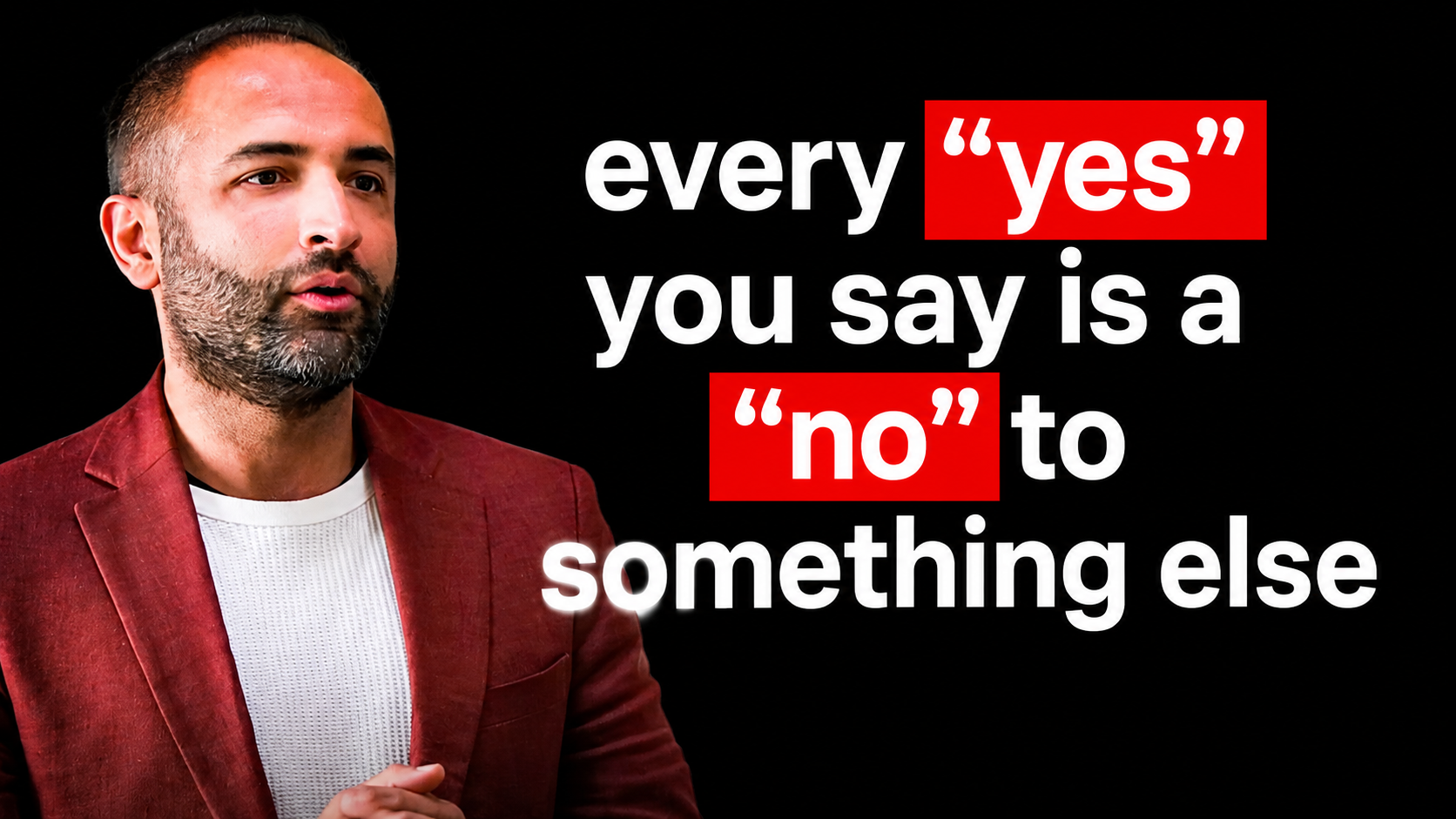
The Power of No: Every "yes" you say is a "no" to something else
Jun 10, 2026The Power of Saying No: Why Every Multifamily Investor Needs Better Boundaries
Your Biggest Competitive Advantage May Not Be What You Say Yes To
In multifamily investing, opportunities are everywhere.
New deals.
New partnerships.
New markets.
New networking events.
New business ideas.
At first glance, this seems like a good problem to have. But many investors discover that saying "yes" to everything eventually creates overwhelm, burnout, and distraction.
The truth is:
Your success is determined just as much by what you say no to as what you say yes to.
Because every "yes" comes with a hidden cost.
And every "no" protects something valuable.
When Your Business Controls You Instead of the Other Way Around
Many entrepreneurs begin their journey in reaction mode.
They wake up checking emails.
Refresh messages.
Wait for brokers to call.
Hope investors respond.
Worry about where the next opportunity will come from.
Instead of operating from a plan, they're operating from fear.
And what starts in business eventually spills into every area of life.
The stress from unanswered emails follows you home.
The uncertainty from the market affects your relationships.
The anxiety around your business becomes the soundtrack running in the background of your life.
For many investors, the issue isn't lack of opportunity.
It's lack of intentionality.
The Shift From Reactive to Proactive Living
Everything changes when you stop asking:
"What if opportunities don't come?"
And start asking:
"What kind of life am I trying to create?"
This shift moves you from reacting to circumstances to intentionally designing your life.
Successful investors don't build their calendars around fear.
They build them around vision.
Instead of waiting for things to happen, they proactively schedule:
-
Investor outreach.
-
Broker relationships.
-
Asset management activities.
-
Personal health.
-
Family time.
-
Strategic planning.
When your life is driven by purpose rather than panic, decisions become much easier.
Why Vision Must Come Before Boundaries
Most people struggle with saying no because they haven't defined what matters most.
Without a clear vision, every opportunity feels important.
But when you know what you're building, saying no becomes easier.
Ask Yourself:
-
What does success actually look like for me?
-
What kind of lifestyle do I want?
-
What kind of spouse, parent, or leader do I want to become?
-
What am I ultimately building this business for?
Until these questions are answered, boundaries will always feel uncomfortable.
Because boundaries only make sense when they're protecting something meaningful.
Every Yes Has a Cost
One of the most powerful questions any multifamily investor can ask is:
"If I say yes to this, what am I saying no to?"
Most people only think about money.
But the real costs are often hidden.
A new opportunity may cost:
Time
Those extra meetings could take hours away from your highest-value activities.
Energy
A promising project can drain you emotionally and mentally.
Relationships
More work may mean less presence with your spouse or children.
Health
Late nights and constant stress eventually take a toll.
Peace of Mind
Some opportunities create more anxiety than value.
The true price of an opportunity isn't always measured in dollars.
Sometimes it's measured in energy, focus, and quality of life.
Every No Protects Something Valuable
Saying no isn't selfish.
It's strategic.
Whenever you decline something, you're protecting:
-
Your time.
-
Your health.
-
Your family.
-
Your focus.
-
Your sanity.
-
Your long-term goals.
High-performing investors understand this.
They recognize that every commitment has consequences.
That's why they don't automatically say yes—even to attractive opportunities.
Instead, they evaluate:
"What am I protecting if I say no?"
That question often reveals whether a decision aligns with their values.
Boundaries Create Freedom
Many entrepreneurs fear boundaries because they think boundaries limit growth.
The opposite is true.
Boundaries create freedom.
For example:
-
Blocking time for family protects relationships.
-
Protecting weekends preserves recovery.
-
Scheduling strategic work prevents constant firefighting.
-
Limiting distractions increases productivity.
Without boundaries, everything becomes urgent.
And when everything is urgent, nothing receives your best energy.
Not Every Opportunity Is Worth Pursuing
One of the hardest lessons in real estate investing is learning that good opportunities can still be bad fits.
Sometimes the numbers work.
Sometimes the money looks attractive.
But if the partnership, culture, or people involved create constant stress, the cost may be too high.
Many experienced investors have turned down profitable opportunities because they understood:
Peace of mind has value.
Your business should enhance your life—not diminish it.
Why Systems Make Saying No Easier
Decision fatigue is real.
The more decisions you make, the more energy you consume.
That's why successful investors rely on systems.
These systems may include:
-
Calendar blocks.
-
Weekly planning sessions.
-
Quarterly goals.
-
Investment criteria.
-
Family commitments.
-
Personal routines.
When your priorities are already scheduled, you don't have to reinvent every decision.
Your systems make the decision for you.
And saying no becomes far less emotional.
Questions Every Multifamily Investor Should Ask
Before committing to anything, consider these questions:
If I say yes to this, what am I giving up?
Does this align with my long-term vision?
Will this increase or decrease my energy?
Is this helping me become the person I want to be?
What am I protecting if I choose to say no?
The quality of your life is often determined by the quality of your decisions.
And the quality of your decisions is determined by the clarity of your priorities.
Final Thoughts
In multifamily investing, success isn't about doing everything.
It's about doing the right things.
The word "no" isn't about rejecting people.
It's about protecting your vision.
Because every time you say no to distractions, you're saying yes to something more important.
Your family.
Your health.
Your peace of mind.
Your long-term goals.
And ultimately, the life you're working so hard to build.
Remember:
Every "yes" is a "no" to something else.
Choose wisely.
TRANSCRIPT
Today we are talking about the power of
0:03
no. But that wasn't the reality. The
0:05
reality was was I was kind of in
0:07
reactionary mode to when are people
0:10
going to reach out to me to ask for my
0:13
services, ask for my business um and
0:16
when am I going to make sales. That was
0:18
one side. The other side of it because I
0:20
was so obsessed with that and because I
0:21
was not it was not working. I would
0:24
carry the same energy into my home
0:27
whether I was with my kid or I was with
0:30
my wife or somebody else. There was a
0:32
pro like a voice running in the
0:34
background like you know those you
0:35
listen to a song and that gets stuck in
0:37
your head for days. But this would be
0:40
like oh when is the next sale going to
0:42
come from when is this going to come
0:43
from? When is what if this doesn't work?
0:45
What if that doesn't work? And so that
0:47
reaction determined how I operated every
0:49
day. It was reaction to those that
0:51
thought process around the business
0:53
side. The same reaction would carry into
0:54
my life and pretty much my days were
0:57
structured around how I would react.
0:58
Thank you for joining us here for this
1:01
video. We've noticed that there are
1:02
certain percentage or a high percentage
1:04
of our audience haven't uh subscribed to
1:07
our channel. If you can please click on
1:09
the button to subscribe the channel uh
1:11
to the channel, it will help us create
1:13
more content. that will help us which
1:15
will help us reach more amazing people
1:17
like you to support them to serve them.
1:19
So please click on the subscribe uh uh
1:22
button uh and I'll see you on the next
1:24
video. Thank you. Bye. But today we are
1:29
talking about the power of no.
1:33
I never know if you're seeing it this
1:34
are you seeing it the right way or the
1:36
wrong way? The right way. Okay. Okay.
1:38
Because I think I've mirrored it there.
1:40
The power of know. We'll go through why
1:43
it's important to say no. We all kind of
1:45
intellectually know this, but I want to
1:47
drill down a little bit about why it's
1:49
important. What happens when we do say
1:52
no or when we do say yes, yes to
1:55
something, what is the cost of it? And
1:57
and what are the things we need to say
1:58
to uh say no to? What are the things we
2:01
need to say yes to? And and this can be
2:03
a huge conundrum especially if you're
2:05
somebody who is juggling m multiple
2:07
things from your personal life to uh
2:11
your professional life or multiple
2:12
businesses or a job in a business
2:14
whatever that looks like in your world.
2:17
uh there are so many opportunities for
2:18
you to either say yes usually a lot of
2:21
opportunities say say yes and the harder
2:24
thing to do is to say no and I'll I'll
2:26
start with the story around this years
2:28
ago years ago and um if you looked at my
2:31
life um I'd say 8 years ago or a decade
2:36
ago uh this is what it looked like I
2:39
would wake up in the morning first thing
2:41
I did was check my email and that was
2:44
around the time when I started a
2:46
business as Well, and I kept refreshing
2:48
the email and this is why I refreshed
2:50
the email. Some of you like, where how
2:54
come nobody's sending me messages to ask
2:57
for my services? How come nobody's
2:58
responding back? Like, is there
3:00
something wrong with my email to the
3:01
point where there was actually one time
3:03
there was something wrong with my email,
3:04
but that was a whole It kind of made me
3:06
feel better for a moment cuz I talked to
3:07
the customer service. They're like,
3:08
"Yeah, there was for two days there was
3:10
something wrong with your system." Like,
3:12
"Oh, there might have been so many
3:13
messages come through." But that wasn't
3:16
the reality. The reality was was I was
3:19
kind of in reactionary mode to when are
3:21
people going to reach out to me to ask
3:24
for my services, ask for my business,
3:27
um, and when am I going to make sales.
3:29
That was one side. The other side of it,
3:31
because I was so obsessed with that and
3:33
because I was not it was not working, I
3:36
would carry the same energy into my home
3:39
whether I was with my kid or I was with
3:42
my wife or somebody else. there was a
3:44
pro like a voice running in the
3:46
background like you know those you
3:47
listen to a song and that gets stuck in
3:49
your head for days but this would be
3:52
like oh when is the next sale going to
3:53
come from when is this going to come
3:55
from when is what if this doesn't work
3:57
what if that doesn't work and so that
3:59
reaction determined how I operated every
4:01
day it was reaction to those that
4:03
thought process around the business side
4:05
the same reaction would carry into my
4:06
life and pretty much my days were
4:09
structured around how I would react I
4:11
would do certain things I would try a
4:12
bunch of tough, but they were in
4:15
reaction to that thought process. And
4:17
and I'll share the opposite of that too
4:19
in a little bit. For years, that didn't
4:21
work. For two to three years, that
4:23
didn't work. And then finally, as I sat
4:26
down with my coach and and one of the
4:28
things that I was asked was, well,
4:30
what's your how do you make decisions?
4:33
How do you make decisions around saying
4:35
yes to something versus no to something
4:37
else? First of all, I hadn't even
4:39
thought about that. I'm like, "Well,
4:40
I'll say yes to anything right now
4:42
because because I need business." He's
4:44
like, "Well, that's good, but you still
4:46
need some kind of structure. When you
4:48
look at your calendar, how do you
4:50
structure your days? How do you put
4:51
something on your calendar versus you
4:53
don't? How do you put meetings? How do
4:54
you like I don't know. I'm waiting for
4:57
people to put themselves on my
4:58
calendar." It's like, huh, interesting.
5:00
Do you have control over that? And my
5:04
answer is no. It's like, I can only
5:05
reach out to people. I can only connect
5:07
to people. I don't have control over who
5:09
gets on my calendar on the sales side.
5:12
But in the meantime, I had control over
5:14
who I can reach out to, who can I could
5:16
put on my calendar. And same thing on my
5:18
personal side. I would say to myself
5:20
that I don't have time for the personal
5:21
side, but usually when I would sit
5:23
there, I'm thinking about what am I
5:25
going to do today to get more business,
5:28
more clients, and those kind of things.
5:29
So everything was in reaction to that
5:32
fear of not having clients or that that
5:34
that reaction of not getting business or
5:38
not understanding my marketing and sales
5:40
process all that stuff I didn't have any
5:43
um any control over my calendar my time
5:46
and hence my energy was constantly
5:48
drained but over time what I learned was
5:52
that I need to create a routine where in
5:55
the craziness of business the
5:57
uncertainties of the
5:59
I have some level of control over what
6:02
am I doing and I didn't know it at the
6:04
time but it created something powerful
6:06
that no matter what was happening in
6:08
business I started doing very similar
6:10
things
6:12
and it started and it started with a
6:15
vision that you know what here's what I
6:17
want my life to look like when I am
6:19
successful
6:20
I want my life to be like this I wanted
6:22
to wake up on Monday mornings excited to
6:25
start my day and my week I I wanted to
6:28
take care of myself. I wanted to do
6:30
certain work to connect with people. Um,
6:34
and that could be on the marketing side.
6:35
And but I didn't frame it as marketing.
6:37
I wanted to reach more people because I
6:39
thought my message was important.
6:42
I wanted to work with somebody on a
6:44
consistent basis. In fact, I made a
6:45
decision that it didn't matter what I
6:47
did. 5 days out of the week, I had to
6:50
coach somebody, even if that was one
6:52
person a day. And that was a commitment
6:54
I think I made around seven, eight years
6:56
ago. And to this day, I've I've kept
6:58
that commitment minus vacation weeks or
7:01
some weird weeks where I'm not I'm doing
7:03
focus on some project on the marketing
7:05
side. Um I always have a group or
7:06
one-on-one session schedule. In fact,
7:08
that's one of the best ways I feel like
7:10
a coach. I feel motivated. I feel like
7:12
I'm serving people. So um so here's what
7:16
started happening. I started actually
7:18
structuring things into my calendar. I
7:20
stopped waiting for my email to send me
7:22
something. I started putting down you
7:24
know what um every uh Monday morning I
7:28
start with looking at what do I need to
7:30
do for the month for the week for and
7:34
that started becoming more and more and
7:36
more and I started putting down who do I
7:39
need to reach out to. I wasn't waiting
7:40
for people anymore. I started reaching
7:42
out to people. started connecting with
7:44
people on a regular basis
7:47
and I started actually finding people to
7:48
to coach and train. I didn't I didn't
7:50
care if it was uh it was uh free paid
7:54
one-on-one group. I'm like this is my
7:57
job. I got to if I'm not coaching
7:59
people, I'm not a coach.
8:01
I don't care how much marketing I do.
8:03
Like I I need to reach out to somebody.
8:05
And so I started reaching out to people
8:06
like a crazy person whether they wanted
8:08
it or not. And I started coaching
8:09
people, family, friends, whoever. Um,
8:12
and then I started putting down like the
8:14
things that were connected my vision
8:16
around what my ideal life looked like.
8:17
So I started putting down like even 30
8:19
minutes of taking care of myself even
8:21
points where
8:24
I would take a break and feel like you
8:25
know what I I deserve that break
8:27
throughout the day even though I I don't
8:30
have the clients even though I don't
8:31
have the business yet. uh I started uh
8:34
reaching out to other people to connect
8:36
with them to uh to join do joint
8:40
ventures of different kinds on the
8:42
business side. A lot of times it didn't
8:43
work sometimes it worked. Basically I
8:46
started to see a structure develop on my
8:48
calendar and pretty soon when I would
8:51
get an email or a call be like ah you
8:53
know I have something on my calendar for
8:55
that time let me take a look at it would
8:58
you be able to do this and that's when
9:00
the magic happened.
9:02
is that I stopped I wasn't saying yes
9:05
anymore. I I was saying no or I was
9:07
redirecting to a time that was available
9:11
when and and the reason why I'm sharing
9:12
this is that it started with the
9:14
intention that I'm not going to be
9:16
reactive to what I don't have. I'm going
9:18
to be proactive in what I do want to
9:20
create in my life. And that was based on
9:22
a vision.
9:24
That was based on a goal system. That
9:26
was based on a strategy rather than oh
9:29
my god, what's going on with the
9:30
economy? Oh my god, what's going on? Why
9:31
aren't there clients coming in? Or this
9:33
problem, that problem? Why why is this
9:35
person not not not doing this? No, here
9:38
are the things I have control over. I'm
9:39
going to show up every day to do this.
9:43
So, that takes us to our first main
9:46
point.
9:48
The first, this is why I work so much on
9:50
this is we say no to anything that
9:52
doesn't align with our vision and goals.
9:56
which already implies that we need to
9:58
understand what our vision for our life
10:00
is and what our goals are. And if you're
10:03
in a relationship in your personal life
10:05
with a life partner and your business
10:07
with a business partner, you need to
10:09
know the other person what they want
10:10
ideally because your part will be
10:12
incomplete.
10:15
And that is a more complex part is that
10:17
I needed to understand how my wife
10:19
wanted our life to be. And now as our
10:22
kids are growing older, I I'm getting
10:24
feedback from them. What kind of life do
10:26
they see? Like where do they have fun?
10:27
Where do they connect? Where they get
10:29
disconnected? Where do they feel too
10:30
much pressure from us? Where do they
10:32
feel challenged? Where do they feel
10:34
excited? Where do they feel anything? So
10:36
I'm I'm getting their input. Um as I
10:39
started partnering up with people on
10:41
business side, I started asking what
10:42
what are they looking for? I spent a lot
10:44
of time trying to figure out what my
10:45
partners how they're structuring their
10:47
life because our personal lives are
10:49
different.
10:50
Is this business still aligned with
10:52
their path?
10:54
and then have a common vision that
10:56
supports both of us. And then I started
10:58
hiring people. When I started hiring
10:59
people, I started to dig in more around
11:01
like what's their ambition? What are
11:03
they trying to do with their lives? It
11:04
doesn't matter if they work for me. I
11:06
need to understand how I can support
11:08
them. What is their ambition in this
11:09
process? How do we align?
11:14
And and so that's that really starts the
11:16
process of thinking intentionally and
11:18
strategically at multiple level. And and
11:22
here's the challenge that most people
11:23
don't even have that vision and don't
11:25
have a clear goal system. That means
11:28
that this is what I'm focused on before
11:29
they say yes or no to anybody. So
11:31
whatever you're saying yes or no to, you
11:33
don't even know the consequences of. And
11:36
so which leads me to the next part.
11:40
Whenever you're saying yes to something,
11:44
whenever you're saying yes to something,
11:47
you got to ask this question from
11:48
yourself. And this is what helped me a
11:50
lot when I didn't have a clear vision
11:51
and goals when I was building it. What
11:54
am I saying no to? So if I'm saying yes
11:57
to a business opportunity,
12:00
what am I saying no to here? In other
12:02
words, we're talking about what is the
12:04
cost of the yes.
12:07
And a lot of times it's not apparent
12:09
what the cost is. The cost is not always
12:12
apparent. We think that okay, for
12:13
example, I'll give you some examples of
12:15
it. And and marketing is really people
12:17
who are marketers are really good at
12:19
this. For example, they'll say, "Hey, I
12:20
have a free session coming up at this
12:22
time or here's a free sample of the
12:24
thing. Here's the open house for this
12:26
thing and it's free and it's like I'm
12:28
going to go." You say yes to that.
12:30
You're saying no to in those 2 to three
12:33
hours of time to your energy and to your
12:35
time. So, you better ask yourself, what
12:38
am I saying no to when I say yes to this
12:41
opportunity?
12:43
If you and it goes on the personal side
12:45
too. If you say yes to a personal
12:47
decision, for example, you stay up at
12:49
night to do something until 2 in the
12:52
morning, whatever. What am I saying no
12:54
to
12:55
in the morning? I can't wake up. I can't
12:58
go to the gym. I can't uh I can't do my
13:01
normal stuff. I have to catch up with a
13:04
bunch of stuff. I'm saying yes to that.
13:06
There's a cost to it. So and and to
13:08
clearly kind of articulate that whenever
13:10
we say yes to something we're saying no
13:12
to um no sorry uh moving on from there
13:16
whenever the whenever you say yes to
13:19
that something where there's a cost to
13:21
that the cost is not always measured in
13:24
money a lot of times it's measured in
13:26
energy time sanity
13:30
and sanity can be connected to energy
13:32
but I wanted to kind of highlight that
13:34
because we can give up our sanity by
13:37
starting a new opportunity, by getting
13:39
into something, a new partnership that
13:42
we weren't prepared for, and money.
13:45
Most people, they might just think about
13:47
money or they might just think about,
13:49
uh, it's I don't know if I have the time
13:50
for that, but there's a lot more in
13:52
there. What about your energy, your
13:54
mental, physical, emotional energy, your
13:55
sanity,
13:57
your time with your loved ones? Again,
14:00
ultimately, it's your decision. But if
14:02
you're not even thinking about the cost
14:03
for the yes, then you're not making a
14:05
clear decision. And this is the power of
14:07
having a vision and having a structure.
14:11
And this is why I don't even need to say
14:12
no. Most of the time if somebody gives
14:15
me an opportunity, I'm like, "Hold on."
14:16
And that could be my wife, that could be
14:18
my loved ones, that could be my business
14:19
partner. Hold on, let me look at my
14:21
calendar. Okay. Well, that time doesn't
14:24
actually work. What about this other
14:26
time? Or the recurring things that I
14:29
know. For example, I know I need to get
14:30
off at 5:30 unless it's an exception. I
14:33
don't have anything scheduled after 5:30
14:36
or Fridays after 1:00 p.m. I don't have
14:38
anything scheduled unless it's an
14:40
exception. And those exception, this
14:42
better be a really good reason that I'm
14:44
doing that. And exceptions are by the
14:46
nature of exception once or twice, maybe
14:49
a year.
14:51
And it's hard to stick to those things.
14:53
And it it requires for me it it required
14:55
me to connect to again this connects
14:57
back to your vision. My vision require
14:59
me to be a kind of person with a certain
15:02
type of value system. Which means that
15:03
at 5:30 when I'm done, I have a value
15:06
system that my family is just as
15:08
important as as my work. And that's not
15:11
an easy decision as a business owner
15:12
because there are always things to do.
15:14
There are always things to complete.
15:17
There are always more opportunities. But
15:20
what is the cost of that? The cost of
15:21
that is my kids are growing up and I
15:24
want to be in their lives. That's my
15:25
value system. It doesn't have to be
15:26
somebody else's. In fact, I'll I'll
15:30
share a story of this. My younger
15:31
daughter, I think I might have shared a
15:32
version of this before.
15:35
She she often says stuff like this.
15:37
She'll look at me. She's 6 years old.
15:39
She'll be like, "Uh, especially when I'm
15:41
working." She's like, "Baby, you want to
15:43
play tag?" I'm like, "I can't right now,
15:45
but I can do it later on when I'm done
15:46
work. We can play tag." She's like, "I
15:49
hate coaching." She'll look at me and
15:51
she's very blunt and she knows. like why
15:54
do you hate co coaching
15:57
the way she says it too she's so
15:59
straightforward and she just looks at me
16:00
she's like just taking up my time like
16:03
why do you have to work but no and and
16:06
the same thing I say to her I'll say to
16:08
somebody on the business side like hey
16:09
listen when I'm with you when I'm done
16:12
work um I'm with you do you ever see
16:14
Baba on on on his phone doing something
16:16
else when I'm with you do I pay
16:18
attention and and I have to model that
16:20
because if I'm not doing that she'll
16:21
call it out they're very good at that um
16:25
most of the time I'm with them. If I am
16:27
on my phone, I'm telling them, hey, I
16:28
got to take care of this thing. But I
16:31
tell them like just as it's important
16:32
for Baba it is to be with you at that
16:34
time. It's important for me to be with
16:36
my clients and with my work. And you
16:38
might not understand her right now, but
16:39
it's important for me to do that.
16:42
Even at a six-year-old, she'll look at
16:44
me and she'll give me a look and she'll
16:45
walk away, but she gets it. She gets it.
16:47
Okay, I'm I'm fully with her when I'm
16:49
done. and she sees the value of that at
16:52
least. And and again, that has to be
16:54
connected to a vision of the kind of
16:56
person you want to be. I don't have to
16:57
be 100% like that, but that's the kind
17:00
of person I want to aspire to be in my
17:02
family. That's how I want my kids to
17:04
look at me. And so, yes, I'm saying a
17:07
bunch of nos to business opportunities
17:09
when I'm done at 5:30, but I'm saying
17:10
yes to something that's even more
17:12
important at times.
17:16
And
17:18
the same thing is true on the other
17:20
side. When you're saying no,
17:23
what am I protecting? But it's looking
17:26
at it in a different way. Whenever
17:27
you're saying no, you're protecting
17:29
something.
17:31
And this is also important for us to ask
17:33
this question. So whenever you say no to
17:35
an investment opportunity, whenever you
17:37
say no to a personal opportunity,
17:40
whenever you say no to let's say I don't
17:43
know, taking care of yourself for break,
17:45
what are you protecting? You got to
17:47
think about that same exact things.
17:50
Time, money, energy, sanity. You're
17:52
protecting one of these. The problem is
17:55
that we do this so automatically, we
17:57
don't know why we're doing it. And the
18:00
most important thing is to pause.
18:02
Whether you're saying yes or no,
18:05
what am I saying no to when I say yes to
18:08
this thing? For example, you're here at
18:10
this time. This better be important. And
18:13
I say that genuinely like this better
18:15
adds some value to your life and it's
18:18
important for enough for you to think
18:20
differently for your life, for you to
18:22
show up here. If it's not, I would even
18:23
recommend don't show up here. And I say
18:25
that directly to all my clients. Don't
18:26
show up to a session where you don't
18:28
think it's the most important thing in
18:30
in that week unless you see value in
18:33
this helping you grow. And I say that at
18:36
the risk of it like this better be good
18:38
for people to show up or not. So um the
18:41
other side is al also true. When you're
18:42
saying yes to something,
18:45
what are you saying no to?
18:48
When you're saying no to something, what
18:50
are you protecting in the background?
18:52
And that will tell you a lot about how
18:54
you make decisions. And ultimately as
18:56
leaders, as business owners, our whole
18:58
life revolves around better decisions,
19:01
better decision on investments, better
19:03
decision on our time, better decision on
19:06
our relationships that we're going to
19:07
commit to, better decision on our
19:09
well-being.
19:12
There are times where I've said no to
19:14
like really good opportunities because I
19:16
know a person, how that person is. I'm
19:18
like, if I have to show up to this
19:20
meeting every week and I have to deal
19:22
with this person, I will ruin my
19:24
well-being.
19:26
It will not be worth it for me. Even
19:28
though this would have been a good
19:29
opportunity on the money side and and
19:31
thing, but am I willing to deal with
19:33
this person for the next 6 months? The
19:35
answer was no to me. And I've said no to
19:38
that. Like no, I'm not. Is like I I want
19:41
to be excited to jump on on the call
19:43
with my partners, with my team members.
19:46
That's not always true like 100% of the
19:48
time because there are conflicts you're
19:50
dealing with, challenges you're dealing
19:51
with. But on average, I want to be able
19:54
to to to be excited there and that's a
19:56
value I have around what is that value
19:58
based on the vision for the kind of
20:00
environment I want around me. Why?
20:03
Because my sanity, my health is
20:04
important to me. My days are important
20:07
to me. My time is limited on this earth.
20:10
Who do I want to deal with?
20:13
I'll pause there.
20:16
And uh as a summary, probably the most
20:20
important letter and in in your
20:23
dictionary needs to be no. Not because
20:26
you want to be an ass or you want to say
20:27
to know a bunch of people just for the
20:29
heck of it, but because this creates a
20:31
clear boundary around what you're going
20:34
to focus on. This why people call it
20:35
boundary, but they don't know what they
20:37
mean. But this means that this protects
20:39
your vision, goals, and strategy moving
20:41
forward, long-term and short term, which
20:44
which already means that you got to be
20:47
super clear about what matters to you.
20:49
Because if you're not, it's very easy to
20:51
say yes to a bunch of stuff that don't
20:53
matter to you. That could be multiple
20:55
different opportunities. That could be
20:56
all kinds of stuff that later on you
20:58
look at like, why did I say yes to that?
21:03
And every time you say no
21:06
and every time you say yes, you've got
21:08
to understand the what you're saying no
21:11
to and assess it. If it's worth it,
21:13
great. If it's not, change that. But be
21:16
conscious in that process. Whenever
21:18
you're saying no to something,
21:21
what are you saying yes to?
21:24
That's also important. And I like the
21:27
process of systematizing the whole
21:28
thing, which to me, a calendar system,
21:31
reminders, a project system, a long-term
21:34
goal system, a short they they make it
21:38
automatic, but in a more intentional way
21:40
versus trying to figure out who you're
21:42
going to say no to when your whole
21:43
calendar is open and there's nothing on
21:45
it. There's no, it's too much energy to
21:48
figure out what you're going to say yes
21:50
and no to. So what we're talking about
21:52
is cleaning creating a clear system
21:54
where no and yes become simpler because
21:57
energy takes decisions take a lot of
21:59
energy. And I'll pause here. I'd love to
22:02
know if you can put in the chat what was
22:04
your biggest insight
22:08
out of this
22:10
specifically for you. What is the thing
22:12
that you're going to take away with you
22:14
and you're going to think about or work
Stay connected with news and updates!
Join our mailing list to receive the latest news and updates from our team.
Don't worry, your information will not be shared.
We hate SPAM. We will never sell your information, for any reason.
